
🌙 When Bookkeeping Enters a Dream: Why AaraBookkeeping Makes Accounting Easy for Anyone — Even Masjid Committees
It has been a while since I last wrote about AaraBookkeeping.
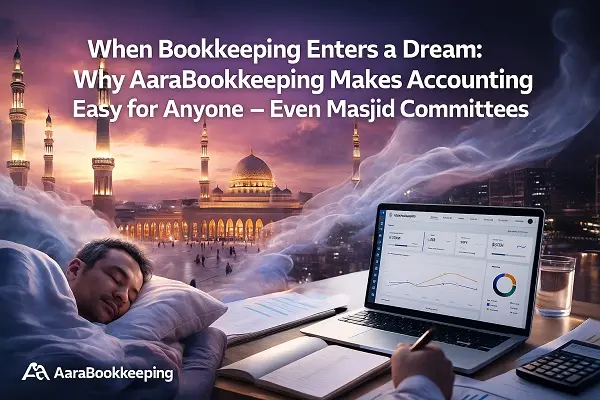
But last night, something unexpected happened — I dreamt about it.
In the dream, I was teaching someone (I think her name was Sharon) how to use the system. No stress, no confusion, no “accounting jargon.” Just a simple explanation of how AaraBookkeeping works.
The dream reminded me of something important:
👉 AaraBookkeeping was built so that anyone can manage accounts — even without accounting experience.
👉 Especially for nonprofits like masjid, surau, NGOs, and small businesses.
And that dream became the inspiration for today’s article.



🕌 Why Even Masjid Committees Can Manage Accounts Easily
Many masjid and surau rely on volunteers — sometimes retirees, sometimes working adults, sometimes students. Not everyone has a background in finance. Yet masjid finances must be transparent, clean, and trustworthy.
This is exactly why AaraBookkeeping was designed to be:
✔ Simple
✔ Transparent
✔ Accurate
✔ Beginner-friendly
✔ Audit-ready
In the dream, I found myself explaining the fundamentals of the system.
Let me share the same explanation here — in case it benefits your organisation too.



💡 AaraBookkeeping Uses Double Entry — But Made Simple for Everyone
Most people tremble when they hear the words double entry.
Padahal konsepnya sangat mudah — especially for a masjid.
1. Faham Akaun Asas: Bank & Cash
These two are the heart of most nonprofit transactions:
- Bank
- Cash
And the rules are very simple:
💸 Money keluar → Credit Bank/Cash
💰 Money masuk → Debit Bank/Cash
That’s it.
2. Pair With The Second Account
Every transaction needs a pair.
If money moves in or out of Bank or Cash, it must be paired with another account that explains what the money is for.
Here are the common categories:
Expenses
- Utility
- Stationery
- Maintenance
- Cleaning
- Honorarium
- Consumables
- Repairs
- Internet
- Water bill
- Electricity bill
- Transport
- Printing
- Event expenses

🖥️ Asset Purchases
- Computer
- Carpet
- PA system
- Projector
- Cabinets
- Air-conditioning
- Furniture
- Renovation assets
💰 Income (Very Important for Masjid / NGOs)
When money comes in, you pair Bank/Cash (Debit) with:
- General Donation
- Friday Prayer Collection
- Sadaqah
- Waqf Contribution
- Rental Income (e.g., hall/space rental)
- Classes or Program Fees
- Fundraising Income
- Event Contributions
- Grants/Subsidies
- Membership Fees
These categories help the masjid track where funds are coming from — crucial for transparency and community trust.
If you can recognise the category, you can do the entry.
That is the entire beauty of AaraBookkeeping:
You don’t need to be an accountant — just identify the type of income or expense, and the system handles the rest.
3. Do It Daily for Transparency
I remember saying this in the dream:
“Better to update daily.
Not only does your audit trail stay clean —
you can print the weekly report and place it on the masjid notice board.
It builds trust with the community.”
And it’s true.
A masjid that displays weekly or monthly financial summaries gains tremendous trust from its jemaah. People contribute more when they see transparency.
📊 AaraBookkeeping Helps Masjid Build Trust
Here’s what many committees love:
✔ Clean audit trail
✔ Clear documentation
✔ Easy reporting
✔ Transaction history with dates
✔ Instant monthly & yearly summaries
✔ Accessible from anywhere
✔ Designed for NGOs & small organisations
Even if committees rotate every year, the records stay structured.
🧪 Try It Yourself: Free Demos
If you want to explore without commitment:
🕌 Demo Masjid
🧾 Demo Small Business (MSME)
Just log in and play around.
Try entering a transaction.
Try printing a report.
Feel how effortless bookkeeping can become.
📝 Learn More About Bookkeeping
For more guides and articles, visit:
https://blog.aara.cloud/bookkeeping
❤️ Closing Thoughts
Maybe the dream was a reminder.
AaraBookkeeping has always been more than software — it’s a tool built to empower everyday people. Volunteers. Small business owners. Committee members.
Because transparency shouldn’t be difficult.
And managing accounts shouldn’t require a finance degree.
Sometimes, even a dream knows how important that is.

Leave a comment
Your email address will not be published. Required fields are marked *